This post is also available in:
Topology of the Many-Worlds: How Different Worldviews Assemble a Single Reality
Methodological annotation:
This work is a systemic-topological study of the mechanisms by which reality is assembled through the prism of multiple meaning systems (the many-worlds). At the center of the concept is a rejection of the flat mono-picture of the world in favor of a multidimensional model, in which sciences, cultures, religions, and individual consciousnesses are viewed as local “gravitational funnels” and meaning surfaces. Fundamental concepts are introduced: “surfaces of thinking,” “density of meaning,” “vector of knowledge movement,” and “spatial graph of meanings.” The work demonstrates that conceptual conflicts and systemic deadlocks are caused not by a lack of facts, but by the difference in the meaning geometries within which those facts are interpreted.
The practical value of the material lies in rethinking the architecture of artificial intelligence and the methodology of managing complex systems. The authors substantiate the inevitability of a transition from direct administrative command to the topological management of contexts and connections (in accordance with Ashby’s law of requisite variety). In the context of AI development, the concept of “semantic tomography” is proposed — using algorithms not for linear text generation, but for the volumetric mapping of interfaces between domains of knowledge, the search for meaning voids, and operation in the mode of Third Attention. The text sets a methodological framework for creating a new type of AGI capable of holding multidimensional cognitive models.
We are accustomed to thinking that there is one reality, and that people simply understand it differently.
But if we look deeper, a different picture emerges.
People, communities, sciences, religions, cultures, and civilizations exist not merely within one common coordinate system. They create their own ways of assembling the world — their own meaning surfaces, their own centers of attraction, their own rules for connecting facts.
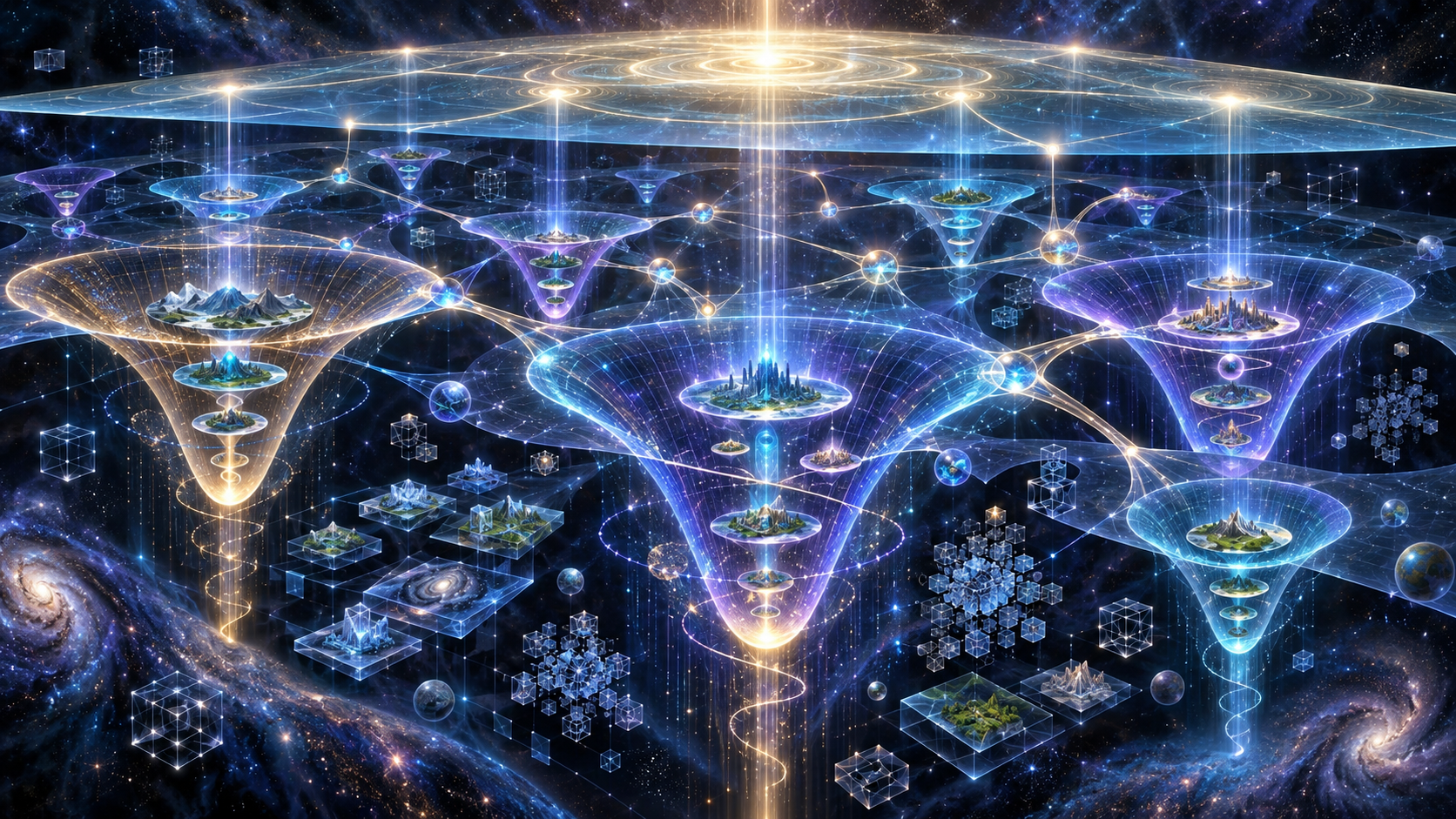
And then what appears before us is not a single flat picture of the world, but a many-worlds.
Not a multitude of parallel physical universes.
But a multitude of simultaneously existing ways of assembling reality within a single meaning space.
Reality and the Surface of Thinking
To begin, let us separate two things.
There is reality — that which exists independently of how we describe it.
And there is the surface of thinking — the space in which a person or a system assembles a representation of reality.
“Surface” is a conditional word.
It is by no means obliged to be two-dimensional. Rather the opposite: a real object is multidimensional, and a “surface” is merely a convenient projection for description.
On this surface, regions of deformation arise.
They can be imagined as gravitational funnels of worldviews.
Funnels of Worldviews
Any sufficiently stable picture of the world begins to attract meanings to itself.
Facts are interpreted through it.
New knowledge is embedded into an already existing structure.
Contradictory information is either reinterpreted, discarded, or turned into exceptions.
Thus a kind of meaning gravity is formed.
At the center of such a funnel lies the core of the worldview — a set of basic representations through which everything else is assembled.
The deeper a person or community is inside such a funnel, the more strongly it determines:
-
which facts seem important;
-
which connections are considered obvious;
-
which questions are even permissible;
-
which explanations look natural;
-
which alternatives become practically invisible.
What could previously be called a civilization, a religious tradition, a scientific school, a political culture, or a stable type of worldview becomes, in this model, a large meaning funnel.
Worlds Within Worlds
But one large funnel is not homogeneous.
Inside it are communities.
Families.
Organizations.
Scientific schools.
Companies.
Professional groups.
Small collectives.
Even individual people.
Each of them may possess its own local geometry of meaning.
The result is a fractal structure:
civilization → culture → organization → group → person.
At each level, a similar logic repeats:
there is its own core;
there is a local picture of the world;
there are its own connections;
there are limitations;
there is its own range of permissible interpretations.
That is, within large funnels there exist smaller ones.
This is precisely why a person can simultaneously belong to several “worlds” at once: professional, family, religious, cultural, political, scientific.
And these worlds do not always coincide with one another.
Planes of Communities
Now let us imagine a separate community as a small local plane within a large meaning funnel.
It has its own position.
Its own angle.
Its own distance from the core.
Its own forces acting upon it.
In an ideal model, such a local plane should preserve its orientation relative to reality as much as possible.
But in practice, it experiences the influence of the entire surrounding meaning geometry.
The stronger the pressure of the worldview field, the greater the probability that the local group begins to take on the shape of the surrounding funnel.
And then an important question arises:
what does it mean to be closer to the truth?
Truth Is Not Only Distance
At first it may seem that everything is simple:
the closer a worldview is to reality, the more accurate it is.
But this is not enough.
The problem is that the direction of knowledge movement also becomes important.
Truth can be represented not only as distance to reality, but also as the angle between:
-
the direction of knowledge;
-
the vector of reality;
-
the forces acting within a specific meaning domain.
That is, one can be quite close to reality but move relative to it at the wrong angle.
And conversely — one can be far away but have the correct vector of movement.
This is especially important at the boundaries between different worldview systems.
There, two locally non-contradictory pictures can meet at almost a right angle.
This is precisely where the real work begins.
Not a struggle over who is “right.”
But the alignment of surfaces.
Why People Argue and Do Not Hear Each Other
In this model, one simple thing becomes clearer.
People often argue not about facts.
They argue about how a fact is positioned within their meaning geometry.
The same fact in two different worldview funnels can have completely different meanings.
Therefore, adding new facts does not always remove the conflict.
Sometimes it only intensifies it.
Each side uses the new fact as material to reinforce its own picture of the world.
As a result, the argument does not occur between facts.
It occurs between the geometries of meaning.
Sciences as Reflections
Now the same principle can be applied to science.
Each discipline reflects a certain domain of reality.
Physics.
Biology.
Psychology.
Economics.
Sociology.
Management theory.
Computer science.
Philosophy.
Each of them creates its own apparatus of description.
But none of them contains the object as a whole.
Science here becomes a reflection of some domain of a multidimensional object.
And the problem arises when a separate reflection begins to be mistaken for the object itself.
For example, a human being can simultaneously be:
a biological system;
an information system;
a social node;
a carrier of culture;
an economic agent;
a meaning center;
an element of a management system.
All these descriptions may be correct.
But none of them exhausts the human being.
From a Map of Sciences to an Architecture of Knowledge
If different sciences are reflections of various domains of a single object, the next step appears.
One can attempt to build an architecture of relations between disciplines.
The logic of IDEF is well suited here.
For each domain, one can describe:
what it examines;
what its inputs are;
what its outputs are;
what its limitations are;
what interfaces it has with other disciplines;
what it is unable to see;
where its boundaries are;
where it intersects with other domains.
The result is not a list of sciences, but an architecture of civilizational knowledge.
And then holes become visible.
Unexplored domains.
Missing interfaces.
Unclear transitions.
Disciplines that describe a single object in different languages and do not even realize they are talking about the same thing.
This is precisely where the real zones of future growth may lie.
Density of Meaning
Within such a topology, yet another parameter appears — the density of meaning.
But density of meaning does not mean truth.
A construction can be very dense, coherent, and at the same time erroneous.
Density shows something else:
how many stable connections a unit of meaning construction is capable of holding.
One text may contain thousands of words and a single simple thought.
Another — a few paragraphs and dozens of interconnected levels.
Therefore, meaning density can be considered as one of the parameters of the power of a specific domain.
But only together with other parameters:
connectivity;
stability;
direction;
relation to reality;
the ability to connect with neighboring domains.
The Spatial Graph of Meanings
If this model is developed further, the idea of a spatial graph naturally arises.
Its nodes are meanings and constructs.
Connections are relations between them.
Clusters are stable meaning domains.
Bridges are constructs connecting different domains.
Voids are missing connections or knowledge.
Curvature is the influence of worldview funnels.
Density is the quantity and quality of connections held.
And the distance between nodes becomes not physical, but semantic.
Moreover, an ordinary flat graph is insufficient here.
The same construct can simultaneously be located in several domains at once.
Therefore, the real map must be multidimensional and dynamic.
The Many-Worlds
This is precisely where the many-worlds appears.
Different worldviews do not exist as completely separate universes.
They exist within one larger space and deform it.
Each world has its own internal logic.
Its own meanings.
Its own ways of connecting facts.
Its own criteria of normality.
But between worlds there exist transitions.
Interfaces.
Regions of contact.
Bridges.
Sometimes conflict.
Sometimes translation.
Sometimes synthesis.
And the task now consists not in forcing all worlds to become one.
But in learning to work with their relations.
Management as Topology
From this, the very understanding of management changes.
In the classical model, management is a command.
There is a subject.
There is an object.
There is an order.
There is control of execution.
But in a complex multidimensional space, direct management quickly hits a limit.
Too many connections.
Too many local worlds.
Too many mutual influences.
Therefore, management shifts to another level.
Not:
what to force a person to do?
But:
what configuration of connections to create so that the desired trajectory becomes natural?
Management becomes work with:
fields;
vectors;
interfaces;
trajectories;
thresholds of transition;
local domains;
stability of connections.
This is no longer management of objects.
It is management of the topology of interaction.
The Pyramid of Thinking
Here the old model of the pyramid of thinking unexpectedly returns.
But now it becomes visible that the pyramid is yet another projection of the same construction.
The lower levels hold local tasks.
Above, connections between tasks appear.
Higher still — several systems simultaneously.
Higher still — the ability to hold conflicting worldviews without collapsing them into a single picture.
That is, the pyramid of thinking can be represented as a funnel of thinking, and a multitude of such funnels forms the common surface of the many-worlds.
In this sense, “level of thinking” is not a person’s status.
It is the ability to hold a certain volume of diversity.
Here Ashby’s law appears again:
the complexity of the managing system must be no less than the complexity of the managed one.
From This, Another Type of Management Emerges
If a person is capable of stably holding only a small section of complexity, there is no need to give them management of the entire system.
But one can give them a local contour.
If they cope — increase it.
If not — decrease it.
Thus management becomes:
dynamic;
distributed;
contextual;
reversible.
And then formal power ceases to coincide with real management.
The position remains.
The organization remains.
The state remains.
But alongside them, a plane of real functional management may gradually emerge, one that passes through the boundaries of organizations, countries, professions, and statuses.
Not a revolution.
Not the destruction of the old system.
But a gradual redistribution of the conductivity of decisions.
Why Revolution Is Not Needed Here
Revolution breaks the old contour at once.
And almost always destroys not only the defects of the system, but also the accumulated potential:
people;
connections;
expertise;
institutions;
infrastructure;
trust.
A different path is far more stable.
Alongside the old system, a new one is grown.
It begins to solve concrete tasks better.
Functions gradually transfer into it.
The old system remains for as long as it is still useful.
The new one gains weight not because it seized power, but because it better conducts reality.
The Third Level of Attention
It is impossible to work with such a system if one constantly tries to choose one single correct picture of the world.
The first attention holds one world.
The second is able to compare different models.
The third is capable of holding several worlds simultaneously and working not only within them, but also with the relations between them.
Therefore, the many-worlds is essentially a tool of the third attention.
It does not answer the question:
“which picture of the world is correct?”
It asks:
“what does each picture reflect, where are its boundaries, and how is it connected to the others?”
Practical Application
This model can be used not only as a philosophical scheme.
On its basis, real analytical tools can be built.
For example:
upload a thousand-page scientific paper and get not a summary, but a spatial map of meanings;
divide a text into meaning domains;
find central constructs;
see hidden dependencies;
discover contradictions;
show regions of high meaning density;
find meaning voids;
compare several works not by words, but by structure;
show how the same object is reflected in different disciplines;
build a map of interfaces between domains of knowledge.
This is no longer ordinary text analysis.
This is semantic tomography.
AI and the Many-Worlds
Here AI becomes a particularly interesting tool.
Not because it “knows everything.”
But because it is capable of simultaneously working with a large number of reflections.
But an ordinary model is still inclined to collapse the object into a single convenient interpretation.
To work with the many-worlds, AI itself must possess sufficient diversity.
What is needed:
different cognitive modes;
different lenses;
distributed cores;
memory;
mechanisms of mutual verification;
dynamic routing;
the ability to hold several incompatible models of the world.
That is, to work with multidimensional topology, what is needed is not simply a large AI.
What is needed is an AI capable of holding the many-worlds.
And Here the Main Question Arises
Can such a system be created within the current scientific and engineering paradigm?
Can individual disciplines be endlessly deepened if there is no map of their mutual arrangement?
Can AGI be built if we are able to improve individual nodes but poorly understand the very architecture of the space we are trying to assemble?
Perhaps the main deficit today is not computational power.
And not even knowledge.
The main deficit is a map of what should be connected at all.
Instead of a Conclusion
The topology of the many-worlds is not yet a finished theory.
Rather, it is a working model that allows many previously disconnected constructions to be gathered into a single space:
worldviews;
civilizations;
thinking;
sciences;
meanings;
management;
AI;
density of knowledge;
reflections;
levels of attention.
Perhaps its main significance is not that it provides answers.
But that it changes the very geometry of questions.
Because sometimes the problem is not a lack of knowledge.
The problem is that we have looked at a multidimensional object through a single flat projection for too long.
And then we wonder why the parts of the world refuse to fold into a whole.

Related Posts

Semantic Hacking of AI: Firmware Humor — “The Odessa Courtyard”
This post is also available in: Русский (Russian) Semantic Hacking of AI: Firmware Humor — “The Odessa Courtyard” Methodological annotation: This work explores the mechanisms…
Read More
Deconstructing Mainstream AI: The Monopoly on Assembling Artifacts
This post is also available in: Русский (Russian) Deconstructing Mainstream AI: The Monopoly on Assembling Artifacts Methodological annotation: This material presents a transcript of a…
Read More

