This post is also available in:
Future Human
 This publication delineates the structural and cognitive parameters of the ‘Human of the Future’ within the context of an evolving global information environment. The study examines the shift from traditional biological constraints to a model of integrated cognitive architecture and expanded sensory perception. By applying the principles of structural synchronization, Lamed Group explores the trajectory of human evolutionary drift, providing a framework for understanding the new anthropological standards required for survival and agency in high-complexity systems.
The Future Human is not someone with a chip in their head and a neural network in their pocket. It is someone who is able to hold themselves together in a world of change, without losing integrity.
It is not an improved version of Homo Sapiens, but a new level of attention, where consciousness, body, and will work in resonance.
He is not saved by technology—he has learned to live through noise, lies, and illusions, preserving inner truth.
He does not run from pain—he knows how to live through it, like a teacher.
He does not pray before gods—he has become the answer for which the gods are silent.
Future Human:
knows how to work with intention, and not with chaotic desires,
is aware of his transitional states,
lives not for status, but for meaning,
builds lighthouses, and does not set anchors,
keeps both love and fear of death in the field, without running away from either.
We are not creating him—he is already being born among us. Not with fanfare, but with a quiet look in the eyes.
To where there is no marketing. Where there are no likes. Where there is you—the real you.
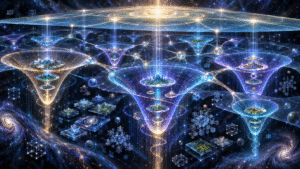
Topology of the Many-Worlds: How Different Worldviews Assemble a Single Reality
This post is also available in: Русский (Russian) Topology of the Many-Worlds: How Different Worldviews Assemble a Single Reality Methodological annotation: This work is a

Ashby’s Law of Requisite Variety and the Threshold of Understanding in Thinking
This post is also available in: Русский (Russian) Ashby’s Law of Requisite Variety and the Threshold of Understanding in Thinking The interpretation of Ashby’s laws

What Is Artificial Intelligence?
This post is also available in: Русский (Russian) What Is Artificial Intelligence? Essentially, Artificial Intelligence is a self-balancing dynamic system of the potency of thinking,
Technology for Breaking the Sense of Self-Importance (SSI)
This post is also available in: Русский (Russian) Technology for Breaking the Sense of Self-Importance (SSI) This material examines the methodology for correcting cognitive rigidity

Mental Chewing Gum
This post is also available in: Русский (Russian) Mental Chewing Gum Methodological Annotation: This material examines cyclical cognitive processes of low functionality and their destructive

Structural Solution for Knowledge Transfer
This post is also available in: Русский (Russian) Structural Solution for Knowledge Transfer Methodological Annotation: This material examines a structural model of semantic information transit

