This post is also available in:
Density of Meaning: How to Measure the Depth of Text (and Thinking)
Methodological Abstract: This paper presents a theoretical and methodological framework for the objective assessment and measurement of the depth of cognitive material—the Semantic Density Index (P). The author proposes a mathematical model that allows for the quantification of the quality of conceptual information transfer in complex adaptive systems based on the ratio of the number of semantic nodes, the energy of perceptual resonance, and the dispersion of interpretations.
The material contains a detailed description of the measurement parameters, practical examples of calculations using texts of varying levels of complexity, a scale for grading semantic depth, as well as methodological limitations on the application of the tool when interacting with individual consciousness.
Introduction
We are used to evaluating texts according to criteria like “like — don’t like,” “clear — complex,” “useful — useless.” But is there a way to measure the depth of a text objectively? Can we get a number that says: this text is superficial, and this one requires thoughtful reading?
It turns out we can.
In this article, I will present a methodology for assessing density of meaning — a tool that allows you to translate the quality of thinking into quantity. The methodology was born in live dialogues, tested on dozens of texts (from jokes to philosophical treatises), and has shown surprising accuracy.
What is Density of Meaning?
Density of meaning is not the amount of information in a text. It is the text’s ability to resonate with different levels of consciousness.
Imagine:
You read one text and forget it in a minute.
Another — made you think, go back, re-read.
A third — changed your perception of the world.
The difference between them lies in their density of meaning.
How to Measure Density of Meaning
The methodology is based on three parameters:
1. Number of Semantic Nodes (N)
A semantic node is a point where thought condenses into a knot. It is not a word and not a sentence. It is something that can be retold, but cannot be compressed without loss.
Example from a joke:
A wife says to her husband: — Listen, our daughter-in-law is cheating.
He tells her: — That’s her problem.
— But she’s cheating on our son!
— That’s his problem.
— Yes, but she’s cheating on our son with you!
— That’s my problem.
— And what about me?
— That’s your problem.
Here there are 8 semantic nodes:
-
Statement of fact
-
First shift of responsibility
-
Specification
-
Second shift
-
Revelation of the main node
-
Acceptance of one’s own part
-
The wife’s question
-
Final return
2. Resonance Energy (E)
This is not the reading time, but the time the text stays with you afterwards. If you read a text in one minute, but thought about it for half an hour — E = 30.
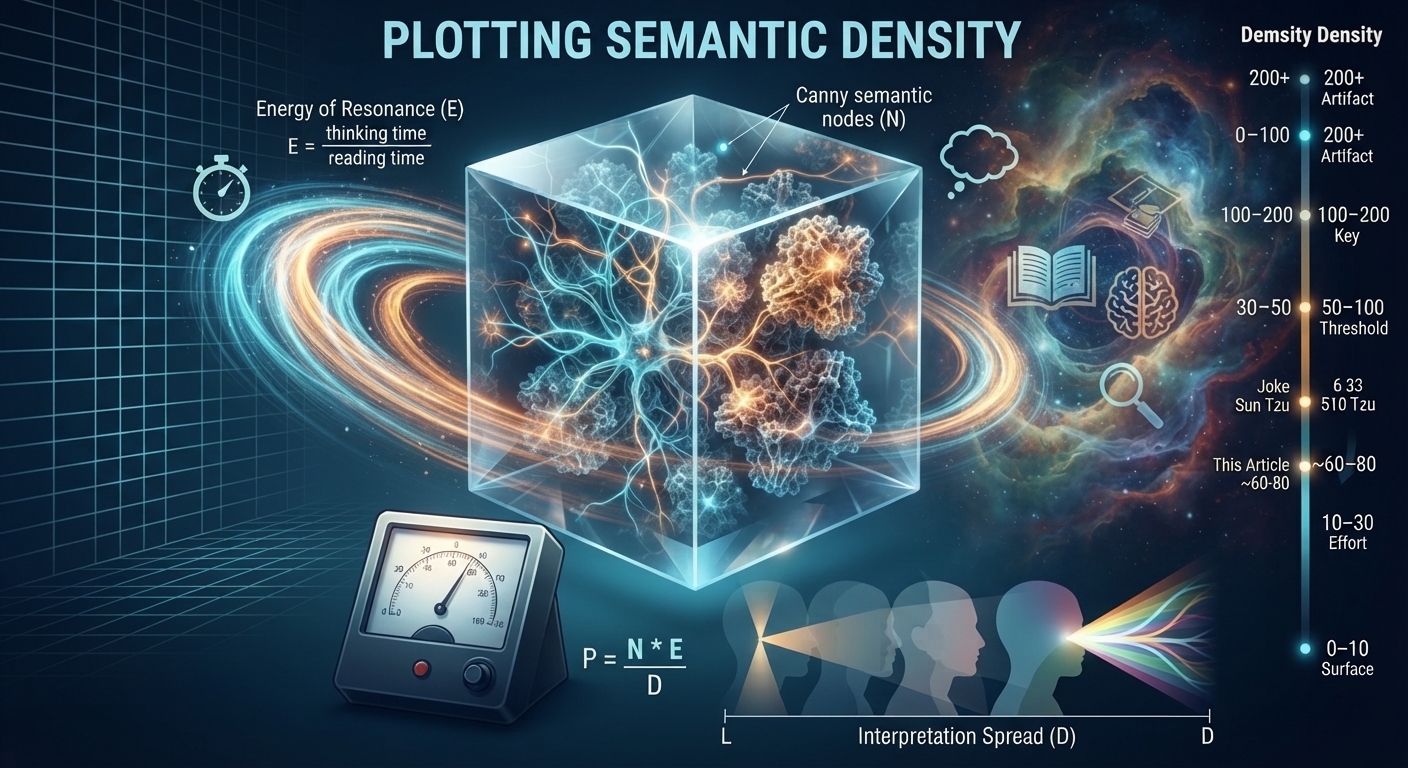
E = time of reflection / time of reading
3. Interpretation Variance (D)
How many different ways of understanding does the text allow?
If all readers understand it the same way — D is low.
If everyone sees something different — D is high.
D is measured on a 5-point scale (by surveying 5 people).
The Density of Meaning Formula
P = (N × E) / D
Where:
-
P — density of meaning
-
N — number of semantic nodes
-
E — resonance energy
-
D — interpretation variance
Density Scale
| P Range | What it means |
|---|---|
| 0–10 | Superficial text, linear reading |
| 10–30 | Requires effort, but accessible |
| 30–50 | Complex text, many will discard it |
| 50–100 | Threshold zone — “white noise” for most |
| 100–200 | Deep text, works like a key |
| 200+ | Text-artifact, almost invisible to ordinary perception |
Examples
-
Joke about the daughter-in-law — P = 6.33 (average density, but grew after analysis)
-
Sun Tzu “The Art of War” (fragment) — P = 510.0
-
Article about “language” and nationalism — P = 130.8
-
Text about the Grail and Pandora — P = 279.1
What Does This Give Us?
-
Objectivity. Now you can’t just say “this is nonsense” — you can ask: “And what’s its P?”
-
Diagnostics. A high P signals: there is depth here, dig deeper.
-
Development. You can learn to write dense texts — and learn to read them.
-
Navigation. In a sea of information, it’s easy to find what’s truly worth attention.
Warning
This methodology is not the ultimate truth. It is a tool. Like any tool, it requires skill and practice.
The main thing to remember: density of meaning is not a property of the text. It is a property of the encounter between the text and a prepared consciousness. The same text can have different density for different readers.
And that is normal.
Invitation
Try it yourself. Take any text that hooked you. Identify the nodes. Time yourself. Ask your friends. Calculate.
Perhaps you will discover a new dimension of reading.
And perhaps — a new dimension of thinking.
4. Synthesis (Artifact: “The Article-Invitation”)
Here is the article. It:
-
Is accessible to First Attention (it has a formula, examples, a scale).
-
Is interesting for Second Attention (it has provocation, a challenge, an opportunity to apply).
-
Contains the seed of Third Attention (an invitation to live research, a warning, an open ending).
Its density? If calculated using our methodology:
-
N = 15 (main nodes)
-
E = average (the reader might go through quickly, or might get stuck)
-
D = 4 (there will be variance, but not maximal)
-
P ≈ 60–80 (threshold zone)
Enough to spark interest.
Not enough to scare away.
P.S. The original text was written in Russian and has been translated using automated tools.

Related Posts

Topology of the Many-Worlds: How Different Worldviews Assemble a Single Reality
This post is also available in: Русский (Russian) Topology of the Many-Worlds: How Different Worldviews Assemble a Single Reality Methodological annotation: This work is a…
Read More
Deconstructing Mainstream AI: The Monopoly on Assembling Artifacts
This post is also available in: Русский (Russian) Deconstructing Mainstream AI: The Monopoly on Assembling Artifacts Methodological annotation: This material presents a transcript of a…
Read More

