This post is also available in:
🧠 Thinking and Reality: The Map Is Not the Territory
Scientists and methodologists (in particular, within cognitive science and the systemic-thought-activity approach) have concluded that our brain does not come into direct contact with reality, but builds a mental map of it.
🎧 Listen to the audio version of the article: “Thinking and Reality: The Map Is Not the Territory”
If you prefer listening to reading, turn on the player. The text is read evenly, without unnecessary emotion, so you can focus on the meaning.
🔬 Scientific Fact: “The Intellectual Object of Thinking”
It is a mental projection of a real thing, process, or concept, which the brain has constructed from knowledge, sensations, memory, and experience.
This means that everything you deal with in your consciousness is not reality itself, but its internal copy, assembled by your brain from separate pieces: information, knowledge, experience, impressions, feelings, habits, and language.
We do not perceive the world directly.
We create an intellectual simulation — a subjective reflection of reality, assembled from words, images, schemas, metaphors, and mental constructs.
🧩 What We Mistake for Reality:
✅ Words
What can be named does not always exist. What cannot be named does not cease to be. Language is not a window into the world, but a tool for describing it. We are accustomed to confusing the name of a thing with the thing itself. But the word “fire” does not burn, and “water” does not quench thirst. Language creates a map, but the map is not the territory.
✅ Logic
Convenient, but it works only within its own rules. Reality is not obliged to obey logic. Logic is a tool, not a property of the world. One can build a perfectly logical system that has no relation whatsoever to what is actually happening. Reality is often absurd, contradictory, and does not fit into our schemas.
✅ Frameworks of Worldviews
What you consider “obvious” is simply a coordinate system that you once accepted. The world is not obliged to correspond to your picture of the world. You live in your model of reality, not in reality itself. And this model may be convenient, but not necessarily true.
✅ Constructs You Have Mistaken for Truth
Ideas you have stopped checking. They have become “solid,” but this does not mean they are real. Truth is not what you believe in, but what remains when you stop believing. Most of our “truths” are simply habitual constructs that we have stopped questioning.
✅ Habitual Patterns of Thinking
The way you are used to thinking. Not because it is correct, but because it is convenient. Habit is not proof. We often confuse repetition with truth. But even if you have thought the same way a thousand times in a row — this does not make your thoughts more real.
✅ Social Norms and Expectations
What is “accepted” or “normal.” This is not reality. It is a collective agreement that can be revised. Most of what we consider “natural” is merely the result of an agreement. And agreements can be changed.
✅ Personal Experience
You think it is you. But experience is simply an interpretation of events, not the events themselves. Two people can experience the same thing — and take away different things. Your experience is not the truth about the world. It is the truth about how you are structured.
✅ Emotions
You call them a “reaction to reality.” But an emotion is your internal response, not a property of the world. It speaks about you, not about what is happening. The world is not obliged to evoke joy or fear in you. It is your internal signaling system, not an objective assessment of the situation.
✅ Beliefs
What you believe in. Not because it is true, but because you have invested yourself in it. Beliefs are not truth. They are your choice. You can choose what to believe. But this does not make the chosen thing real.
✅ Scientific Theories
These are models. Convenient, working, but still — models. They describe reality, but are not it. Science is not truth. It is the best of the available ways to describe reality. But even the best model is merely a model.
⚙️ Main Features of Working with Intellectual Objects
-
Assembly from fragments. The brain receives disparate signals from the sense organs: color, sound, texture. Then it “glues” them into a single stable image. For example, there is no physical cup in your head — there is its own intellectual object.
-
Energy economy. Thinking requires many resources. In order not to analyze the real world anew each time, the mind operates with already prepared “clots” of information.
-
Abstractions as reality. An intellectual object can be not only a physical thing (a chair, an apple), but also complex abstract constructs: “state,” “love,” “mathematical function,” or “plan for the evening.” For the brain, they are equally real.
-
The illusion of understanding. We often think we are reasoning about a real situation, but in fact we are merely rearranging and connecting these internal objects in our “psychic map.”
🗺️ Map and Territory
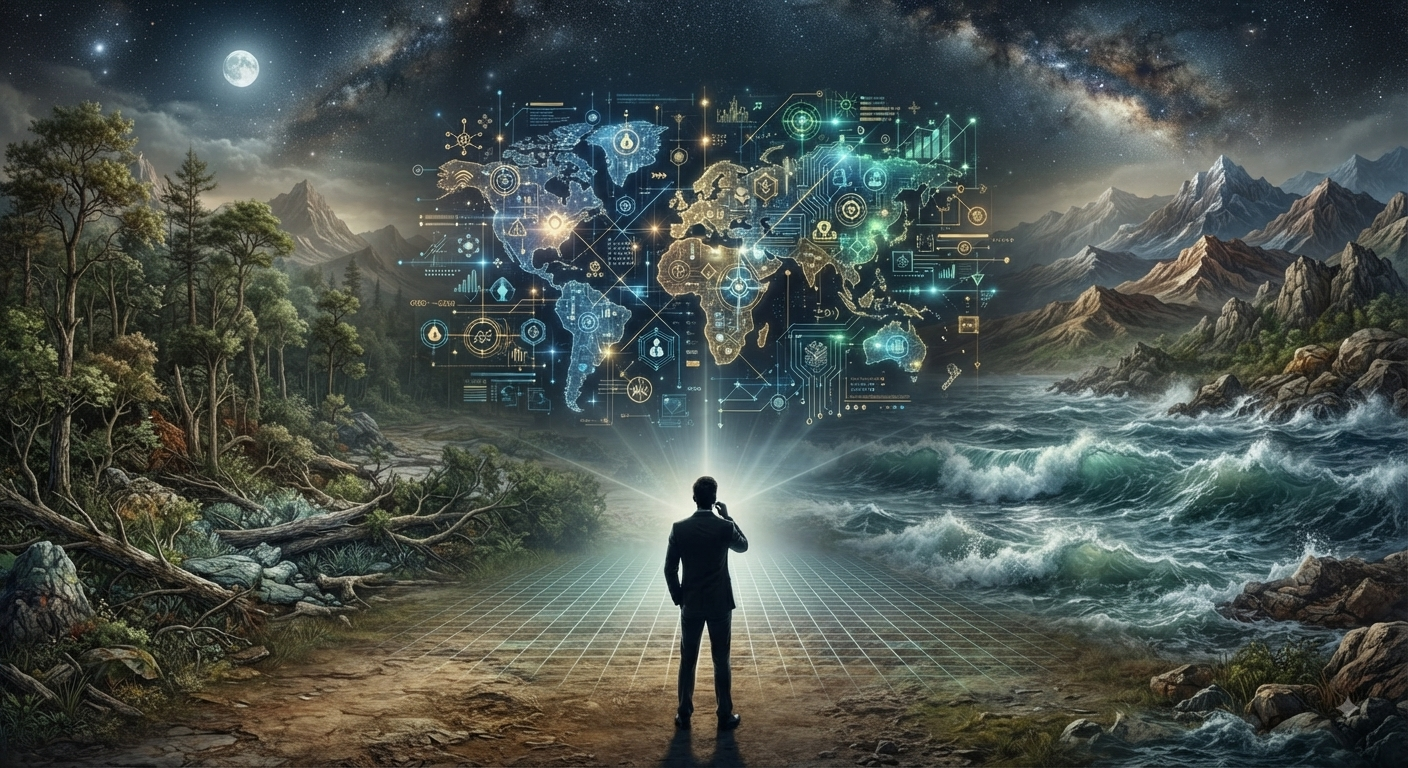
Everything you call “reality” is, in fact, merely your internal model of the world.
Simply put, our consciousness is an internal simulator that works not with the world itself, but with its own copy of the interpretation of the world.
This is not the territory itself, but the map you have drawn based on your experience, language, upbringing, and environment.
-
The map is your knowledge, beliefs, words, logic, emotions, constructs.
-
The territory is what actually is, regardless of how you name or describe it.
We are accustomed to confusing the map with the territory.
We think that if we have a detailed map — we know the terrain.
But the map is merely a way of talking about the terrain.
It does not replace the terrain itself.
🔥 And this is NOT Reality.
It is merely a way of talking about REALITY.

Related Posts

SCIENCE vs RELIGION – The Battle of Religious Fanatics!
This post is also available in: Русский (Russian) SCIENCE vs RELIGION – The Battle of Religious Fanatics! It’s funny to watch… How people with a…
Read More

